EMS Body Sculpting Machines: Technology, Uses, and Buying Checklist
Learn how EMS body sculpting machines work, how salons can use them, and what to check before buying a professional EMS system.
EMS Body Sculpting Machines: Technology, Uses, and Buying Checklist
An EMS body sculpting machine can be a useful addition to a salon or aesthetic studio when it is treated as a structured service tool—not as a substitute for exercise, nutrition, or medical care. EMS uses controlled electrical pulses to create muscle stimulation in selected areas. For a buyer, the important questions are not simply how strong the machine feels or how many pads it includes. You should compare the intended service, number and placement of applicators, control range, training needs, electrical requirements, safety documentation, warranty, and the supplier’s support. A one-handle unit may suit a small studio testing demand, while a multi-handle system may make more sense when the business already has repeat body-contouring clients or wants to serve more than one area in a session.
What is an EMS body sculpting machine?
EMS stands for electrical muscle stimulation. An EMS body sculpting machine sends electrical impulses through applicators placed on selected muscle areas. The impulses are designed to produce repeated muscle contractions. In a professional beauty setting, the service is usually positioned around the appearance of muscle tone, body contouring, and a guided wellness experience.
EMS should be described carefully in customer-facing materials. The device does not replace physical training, diagnose a condition, or guarantee fat loss or a particular body shape. Individual responses vary, and the service must be delivered according to the machine’s instructions, local rules, and the operator’s training. A clear consultation and realistic expectations are part of the equipment decision.
Some products use “EMS,” “HIFEM,” or “HIEMT” in their names. These terms are related but should not be treated as interchangeable. They may describe different pulse patterns, field strengths, applicator designs, or product positioning. Before comparing two quotations, ask the supplier to state the exact technology, operating parameters, recommended use, and test documentation for the model being quoted.
How does EMS work in a salon or studio?
An EMS service normally follows a simple operating sequence:
The operator reviews the client’s goals, relevant health information, and the device’s contraindications.
The selected area is prepared according to the user manual.
Applicators are positioned securely on the intended muscle area.
The operator starts at an appropriate setting and adjusts it gradually while checking comfort and the machine’s response.
The session is ended according to the protocol, the applicators are removed, and the area and equipment are checked.
This workflow matters because the commercial value of the machine depends on repeatable service delivery. A system that looks powerful in a demonstration but is difficult to position, clean, document, or explain may create more operating friction than revenue. Buyers should ask to see the full user manual and a sample treatment protocol before placing an order.
What services can an EMS machine support?
The most common business use is a body-contouring or muscle-stimulation service for areas such as the abdomen, buttocks, arms, or thighs, depending on the model and its approved instructions. A studio may offer EMS as a standalone appointment, as part of a body-care package, or as an add-on to an existing wellness service. The right choice depends on the audience already visiting the business.
For a beauty salon, the priority may be a compact system that is easy to explain and fits into an existing room. For an aesthetic clinic, documentation, operator training, and a clear separation between cosmetic services and medical claims may carry more weight. For a distributor, the priority is broader: dependable specifications, product training, replacement parts, packaging, language support, and a model range that can serve different price points.
Do not build the service menu around a promise such as “instant fat burning” or “guaranteed muscle growth.” A more responsible description is that EMS provides controlled muscle stimulation and may support a body-contouring or muscle-toning service, with results varying by client and protocol. This wording is easier to use consistently across the website, consultation script, and distributor materials.
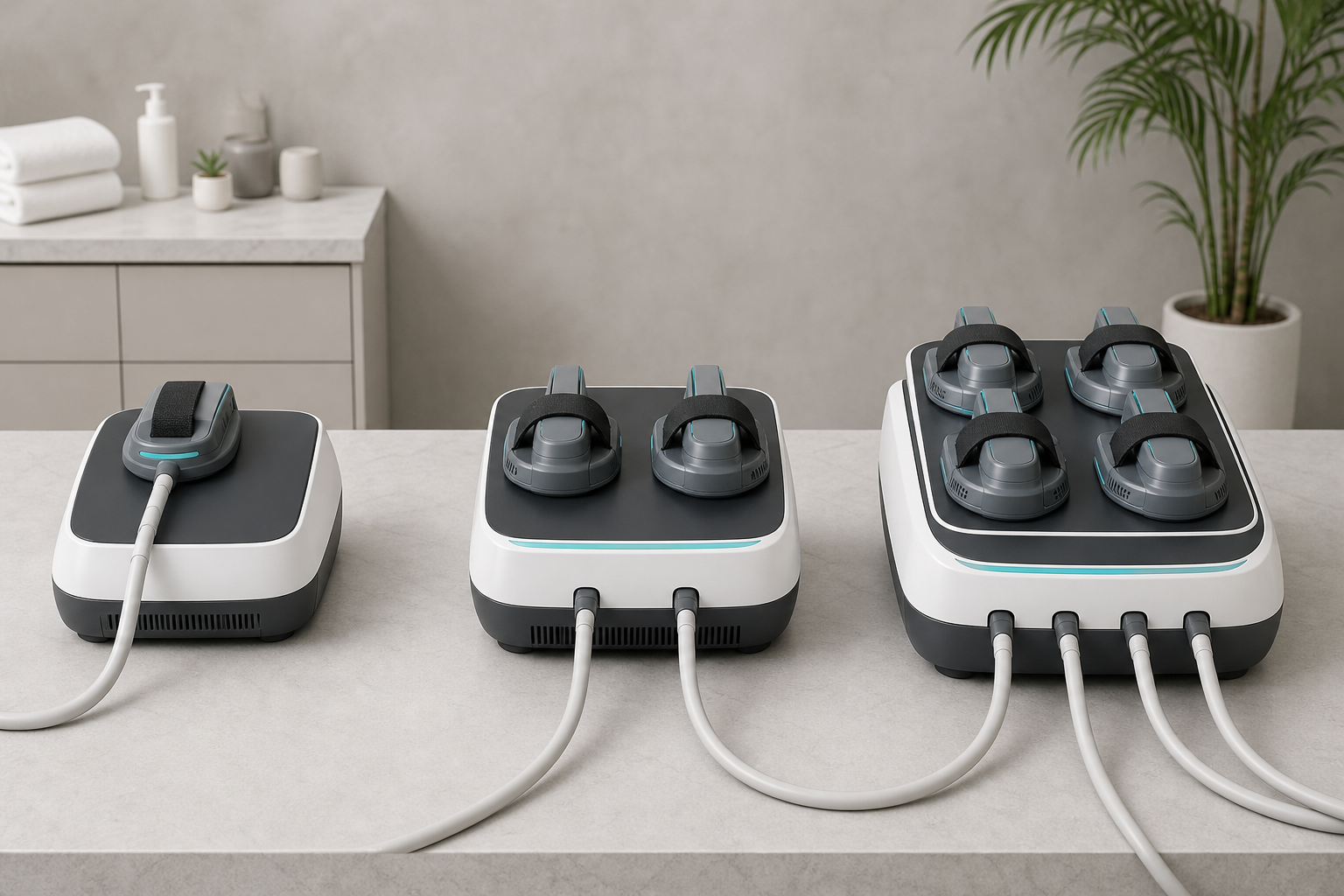
Applicator count affects workflow and capacity; it does not by itself determine equipment quality.
One handle, two handles, or four or more?
The number of applicators affects capacity, workflow, and the type of service you can deliver. It is not automatically a measure of quality.
Configuration | Often suits | Questions to ask before buying |
|---|---|---|
One handle or applicator | Small studios, pilot services, or targeted use | Can the operator reposition it quickly? Is the service time commercially practical? |
Two handles | Studios that want to treat paired areas or improve appointment flow | Can both channels be controlled independently? Are the applicators comfortable and easy to secure? |
Four handles | Established body-contouring services and higher-throughput rooms | Does the room have enough space? Can the operator monitor every channel? |
Sixteen or other high-count systems | Distributors, larger facilities, or specialized service models | Is the capacity supported by real demand, training, documentation, and after-sales support? |
RESCUPL’s current catalogue includes one-handle EMS, four-handle Neo Sculptor, two-handle HIEMT, and a sixteen-handle electric muscle-stimulation body-sculpting model. These options are useful for comparing service capacity, but the catalogue name alone is not enough to select a machine. Request the exact quotation, specifications, included accessories, and applicable user documentation for the model you plan to purchase.
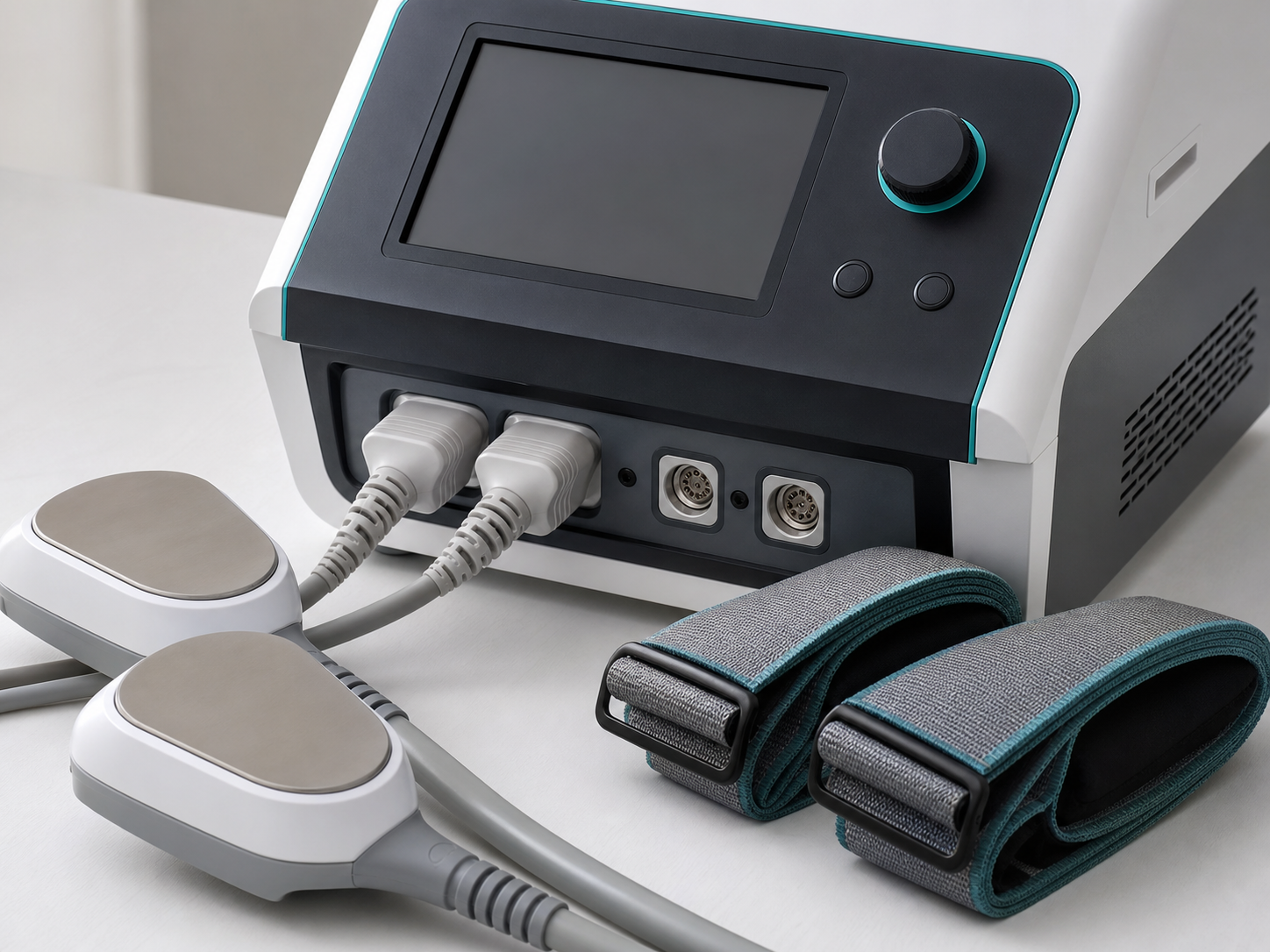
Check controls, electrical details, accessories, and documentation before ordering.
The most important buying criteria
1. Match the machine to your business model
Start with the service you can realistically sell. Estimate how many relevant appointments you currently have, how much room is available, who will operate the equipment, and whether you need one client at a time or a higher-throughput workflow. If demand is untested, a smaller unit or sample order may reduce the risk of buying more capacity than the business can use.
2. Compare controllability, not just maximum intensity
Ask how many channels can be adjusted, whether settings are independent, how intensity is displayed, and whether the machine records or guides operating steps. The operator should be able to make controlled adjustments and stop the session promptly. A clear interface and stable applicator connection are often more useful than a large headline number in a sales brochure.
3. Check applicators and consumables
Inspect the size, shape, cable length, attachment method, cleaning instructions, and replacement cost of the applicators. Confirm whether the package includes enough straps, cables, pads, or other accessories for the promised workflow. For distributors and private-label buyers, ask whether spare parts can be supplied under the same model and whether the packaging clearly identifies the replaceable items.
4. Verify electrical and installation requirements
Confirm input voltage, plug type, power draw, fuse or protection features, room ventilation needs, and whether the unit can be used in your country. A dual-voltage machine is not automatically ready for every market; the plug, labeling, local compliance, and user documentation still need checking. Ask for the final technical sheet rather than relying on a product title.
5. Request safety and compliance documents
Ask for the documents relevant to the product and your market, including the declaration or certification information supplied by the manufacturer, electrical safety records, user manual, and contraindication guidance. Do not assume that a certificate for one model covers a different model. Your local regulator, insurer, or professional association may also have additional requirements.
6. Evaluate training and after-sales support
Before buying, ask what training is included, how technical questions are handled, how quickly replacement parts can be dispatched, and what the warranty covers. A useful supplier should be able to explain setup, cleaning, troubleshooting, and escalation steps in a language your team can use. Keep written records of the agreed support scope.
7. Calculate the service economics
Do not calculate payback from the machine price alone. Include shipping, taxes, installation, staff training, consumables, maintenance, payment fees, marketing, room time, and the cost of discounts or introductory sessions. Then model conservative appointment volume rather than the supplier’s best-case example.
A simple planning formula is:
Monthly contribution = (price per session − variable cost per session) × paid sessions − monthly equipment-related costs
Use the result to compare a one-handle and multi-handle purchase. If the higher-capacity system cannot be filled consistently, its extra capacity may not improve the business. If demand is already strong and the larger system reduces idle time or makes packages easier to deliver, the additional cost may be easier to justify.
Questions to send a supplier before ordering
Use this short checklist in a quotation request:
What exact EMS, HIFEM, or HIEMT technology does this model use?
What are the operating parameters and adjustable ranges?
How many channels can be controlled independently?
What areas and service uses are covered by the manual?
What is included in the standard package?
What are the voltage, plug, power, and installation requirements?
Which safety and compliance documents are available for this model?
What training, warranty, remote support, and spare-parts service are included?
What is the lead time for samples and bulk orders?
Can the machine, interface, packaging, and user materials be customized?
If you are a distributor or own a new beauty brand, add questions about minimum order quantity, territory terms, sample approval, barcode and carton labeling, language versions, and who owns the final design files.
Is an EMS machine right for your business?
An EMS body sculpting machine is worth considering when your business has a clearly defined body-care audience, a trained operator, a suitable room, and a service plan that does not depend on exaggerated claims. The best model is the one whose capacity, controls, documentation, support, and total cost match your actual operation.
If you are still testing demand, begin by comparing a compact one-handle option with the appointment volume you can realistically generate. If you already run body-contouring services or supply multiple studios, compare multi-handle systems by workflow and support—not by handle count alone. For a private-label launch, confirm the sample, interface, packaging, documentation, and quality checks before approving a larger order.
Frequently asked questions
Is EMS the same as HIFEM or HIEMT?
Not necessarily. These labels can refer to different forms of electrical or electromagnetic muscle stimulation. Compare the exact model specifications, applicators, operating instructions, and supporting documents instead of comparing names alone.
Can an EMS body sculpting machine replace exercise?
No. It should be positioned as an equipment-supported cosmetic or wellness service, not a replacement for exercise, nutrition, or professional medical advice.
How many handles should a salon buy?
Choose based on expected demand, room layout, operator capacity, and service design. A smaller system is often easier to test; a larger system may suit an established service with enough appointments to use it.
What should be included in an EMS machine quotation?
The quotation should identify the exact model, technology, operating parameters, accessories, voltage, lead time, shipping terms, warranty, training, spare-parts policy, and available compliance documents.
Can EMS equipment be customized for a private-label brand?
Customization may include the machine logo, startup screen, interface language, packaging, and selected functions, depending on the model and project scope. Confirm what can be changed, the minimum order, sample approval process, and final quality checks before production.
What safety information should an operator receive?
The operator should receive the model-specific manual, setup and cleaning instructions, operating limits, contraindication guidance, emergency stop procedure, and training on applicator placement and intensity adjustment. Follow local requirements and the manufacturer’s current instructions.
Related Equipment