Monopolar RF vs. Bipolar RF vs. RF Microneedling: How to Choose the Right Radiofrequency Device for Your Clinic or Distribution Business
A buyer's guide to monopolar RF, bipolar RF, and RF microneedling — how they differ, who they are for, and how to choose the right platform for your clinic or distribution business.
Monopolar RF vs. Bipolar RF vs. RF Microneedling: How to Choose the Right Radiofrequency Device for Your Clinic or Distribution Business
Radiofrequency (RF) is one of the most crowded categories in the aesthetic equipment market — and one of the most confusing for buyers. Walk through any trade show floor and you'll see "RF" on body contouring machines, facial lifting devices, and microneedling pens alike. But not all RF is the same, and the differences aren't cosmetic. They come down to how the current travels through the electrode, which determines how deep it goes, how much control you have, and which patients and price points it's built for.
For clinic owners deciding what to add to the treatment menu, and for distributors deciding what to stock, understanding the three core RF architectures — monopolar, bipolar, and RF microneedling — is the difference between a device that sells itself and one that sits in a back room.
How RF Energy Actually Works
All RF aesthetic devices rely on the same basic principle: an alternating electrical current passes through tissue, and the tissue's natural resistance converts that current into heat. Controlled heating denatures existing collagen fibers and triggers the wound-healing cascade, which produces new collagen and elastin over the following weeks. The variable that separates one RF platform from another is the electrode configuration — where the current enters the body and where it exits.
Monopolar RF: Deep, Broad, Structural
In a monopolar system, current flows from a single active electrode on the handpiece, through the body, to a grounding pad placed elsewhere on the patient. Because the return path runs through a large volume of tissue rather than back to a second electrode a few millimeters away, monopolar RF can reach considerably deeper — clinical literature puts effective penetration at up to roughly 20mm, reaching well into the subcutaneous layer.
That depth is exactly why monopolar platforms have become the technology of choice for structural skin tightening and body contouring. Recent market activity backs this up: multifrequency monopolar systems have been one of the fastest-adopted RF categories in North America and Europe over the past year, driven by patient demand for non-surgical alternatives to facelifts and body lifts. The tradeoff is that monopolar RF requires more sophisticated energy modulation and cooling to keep the treatment comfortable, since the same broad current path that reaches deep tissue also passes through more of the superficial skin along the way.
Best fit for: clinics and medspas positioning premium, non-surgical lifting and body contouring services; distributors targeting higher price points and physician-run practices.
Bipolar RF: Shallow, Precise, Predictable
Bipolar RF confines the current path between two closely spaced electrodes on the same handpiece. Energy travels from one pole to the other through only the tissue directly between them, so the depth is inherently limited — typically in the 1–4mm range — but far more predictable and easier to control.
This makes bipolar RF the workhorse of everyday facial tightening, skin texture, and "lunchtime" treatments. It's gentler, requires less operator skill to use safely, and is well suited to devices aimed at a broader range of practitioners, including med spas and lower-tier clinics, and even some professional-grade home-use platforms. What bipolar RF gives up in depth, it makes up for in safety margin and consistency across operators — an important consideration for any distributor selling into markets with a wide range of practitioner experience.
Best fit for: facial tightening and texture-focused treatment menus; distributors serving med spas, beauty salons, and multi-location chains where consistent, low-risk results matter more than maximum depth.
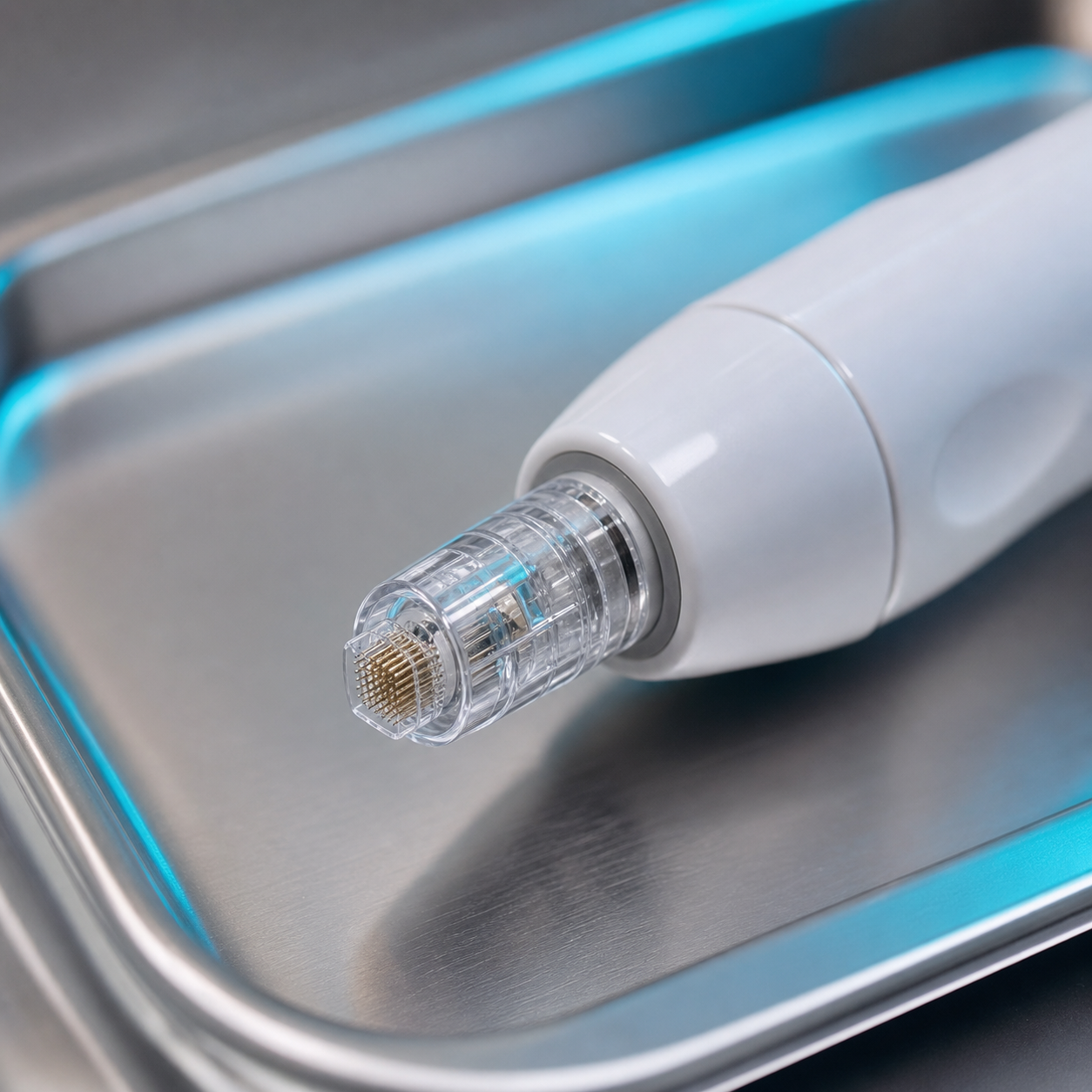
Close-up of an RF microneedling handpiece and insulated needle cartridge.
RF Microneedling: Depth-Controlled and Combinable
RF microneedling adds a third variable: physical needles that carry the RF energy directly into the dermis, bypassing the epidermis almost entirely. Most modern platforms use insulated needles — energy is only released at the needle tip — so the practitioner can dial in penetration depth in fine increments, commonly from about 0.25mm to 3mm, and target the epidermis and dermis separately depending on the concern.
Because the RF energy is delivered under the skin surface rather than through it, RF microneedling causes less surface disruption than ablative fractional lasers while still triggering a strong collagen response, which translates to shorter downtime and broader patient acceptance. It has also become the preferred platform for combination protocols — practitioners are increasingly pairing RF microneedling sessions with topical exosome or polynucleotide serums, using the microchannels created by the needles to improve product absorption. This "device plus serum" bundling is becoming a meaningful revenue driver for clinics and a strong upsell angle for distributors.
Best fit for: clinics building acne scar, texture, and pigmentation protocols; distributors looking for a platform with strong add-on revenue potential through combination treatments.
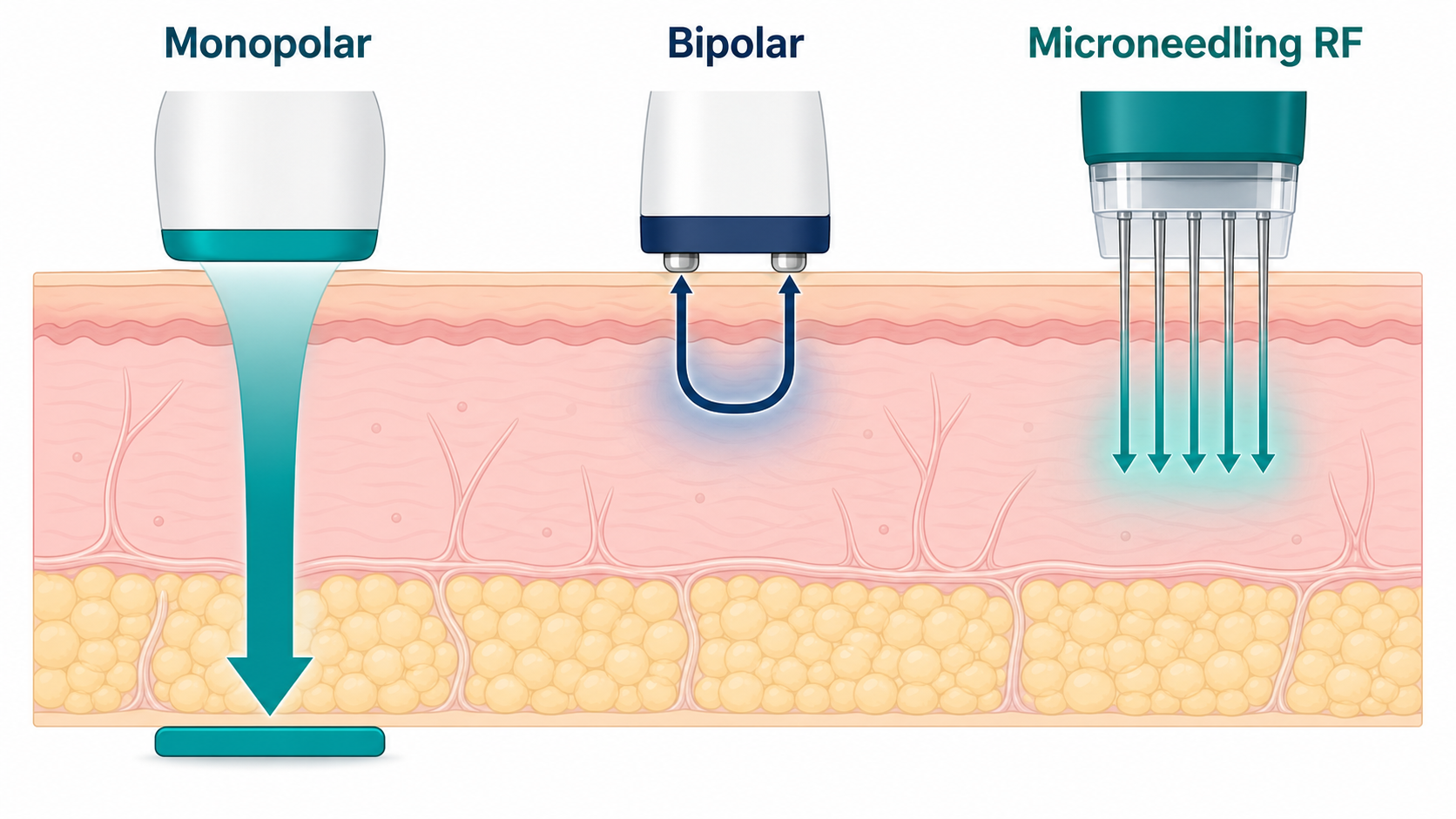
How the three RF architectures differ in energy path and treatment depth.
Side-by-Side Comparison
Monopolar RF | Bipolar RF | RF Microneedling | |
|---|---|---|---|
Typical depth | Up to ~20mm | ~1–4mm | ~0.25–3mm, adjustable |
Mechanism | Single electrode + grounding pad | Two electrodes, current confined between them | Insulated needles deliver RF directly into dermis |
Surface disruption | Low to moderate | Very low | Low (micro-channels only) |
Best use case | Deep tightening, body contouring | Facial texture, general tightening | Acne scars, texture, combination protocols |
Operator skill needed | Higher | Lower | Moderate |
Typical downtime | Minimal to none | None | 1–3 days |
How to Choose: Three Questions to Ask
What does your patient base actually want? Clinics fielding requests for facelift alternatives and body-contouring results should prioritize monopolar depth. Practices built around routine facial maintenance and texture improvement are usually better served by bipolar or RF microneedling.
How experienced is the operator? Monopolar RF rewards a skilled, well-trained operator; bipolar RF forgives a wider range of skill levels — an important factor for distributors selling into multi-location chains or newer med spas.
Is there a path to recurring revenue? RF microneedling's compatibility with serums, exosome add-ons, and multi-session packages tends to generate more repeat visits and higher per-patient spend than a single-modality device.
For many clinics and distributors, the strongest answer isn't choosing one architecture over the others — it's a multifunctional platform that offers more than one RF mode, so the same footprint of equipment can serve multiple patient segments and price points.
Sourcing the Right RF Platform
For distributors and clinic groups evaluating suppliers, the manufacturing details matter as much as the RF architecture: needle insulation quality, impedance-based depth control, cooling systems, and after-sales technical support all affect how a device performs in the field and how few service calls it generates.
RESCUPL designs and manufactures RF microneedling platforms for OEM/ODM partners, medical aesthetic distributors, and clinic groups worldwide, with configurable depth control, insulated needle cartridges, and multifunctional options that pair RF microneedling with complementary modalities. To review specifications, private-label options, and wholesale terms, visit RESCUPL's RF Microneedle Machines product line.
Related Equipment